


The excavator is brought onto a rooftop primarily for demolition work. In certain cases, high-rise buildings cannot undergo controlled blasting due to safety or environmental concerns, and manual dismantling is time-consuming and labor-intensive. In such situations, using an excavator for demolition becomes a practical solution. There are several methods to get an excavator onto a rooftop: it can climb up through debris piled at the back of the building site, ascend via manually constructed spiral staircases, or be hoisted by large cranes or winches.
The most common method involves using a high-capacity aerial lift or a winch system to hoist the machine directly onto the roof. If a winch is used, workers first carry a 5-ton winch up to the rooftop via stairs. The winch is then secured to the edge of the roof. Next, the lifting boom is extended, steel cables are lowered, and the 22-ton excavator is attached. The winch gradually lifts the machine onto the rooftop.
When the building isn't too tall, the excavator can sometimes climb up using its own power. Starting from the ground floor, the operator digs out concrete and rebar, placing them beneath the machine as stepping stones. The excavator rotates upward along these supports, carefully avoiding complete removal of structural columns to prevent collapse. This method is generally not recommended due to its inherent risks.
Another special scenario allows the excavator to climb onto the roof. In some high-rise buildings, each floor's frame forms a "grid" structure resembling a Chinese character " (well). Workers can use a cutting machine to cut three sides of this grid structure, then use oxy-fuel torches to lower the section slowly, creating a sloped ramp with the floor below. This forms a temporary platform that the excavator can climb up step by step. For example, after cutting three sides of the second-floor grid, the entire structure drops down onto the first floor, forming a ramp. To ensure the slope can support the excavator's weight, construction workers must reinforce it with shock-absorbing materials.
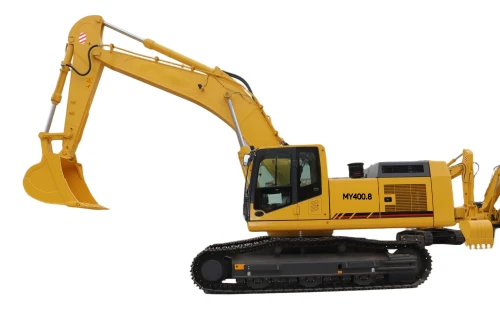
How does the excavator operate on a rooftop?
Once on the roof, the excavator should keep its tracks moving entirely over load-bearing beams to avoid direct pressure on the roof surface. Leveraging the excavator's 360-degree rotating undercarriage, demolition work can be carried out efficiently. Typically, two additional workers assist the operator. During demolition, the driver uses a hydraulic hammer to break through the roof wall panels. The assistants use oxy-fuel cutters to sever reinforcing bars that the hammer cannot handle. Finally, the excavator switches to its bucket attachment-commonly known as the "digging arm"-to remove and dispose of the broken masonry. The debris is usually dumped directly into elevator shafts, which is both convenient and efficient.
Safety Precautions for Excavator Operations on Rooftops
1. Such operations require careful design and thorough calculations of construction loads to confirm that the building can safely support the excavator's weight.
2. The safest method is to use a mobile crane for lifting. Large mobile cranes can hoist up to 1,200 tons, making it relatively easy and safe to lift the excavator onto the rooftop.Crawler Excavator


